
An octopus is a strange animal to begin with.
It has eight arms, three hearts, blue blood, a soft body that can pour itself through impossible gaps, skin that can change color and texture, and enough intelligence to open jars, solve puzzles, escape tanks, and generally behave like a wet alien with opinions.
Then it becomes a parent. And dies.
For many octopus species, reproduction is the final chapter. The female lays her eggs, guards them with obsessive care, stops eating, slowly deteriorates, and usually dies around the time they hatch.
The babies drift away into the ocean.
The mother does not teach them. She does not feed them. She does not show them which crab is lunch. She gives everything to the eggs, and then the story moves on without her.
Nature has chosen tenderness and horror and filed them under the same process.
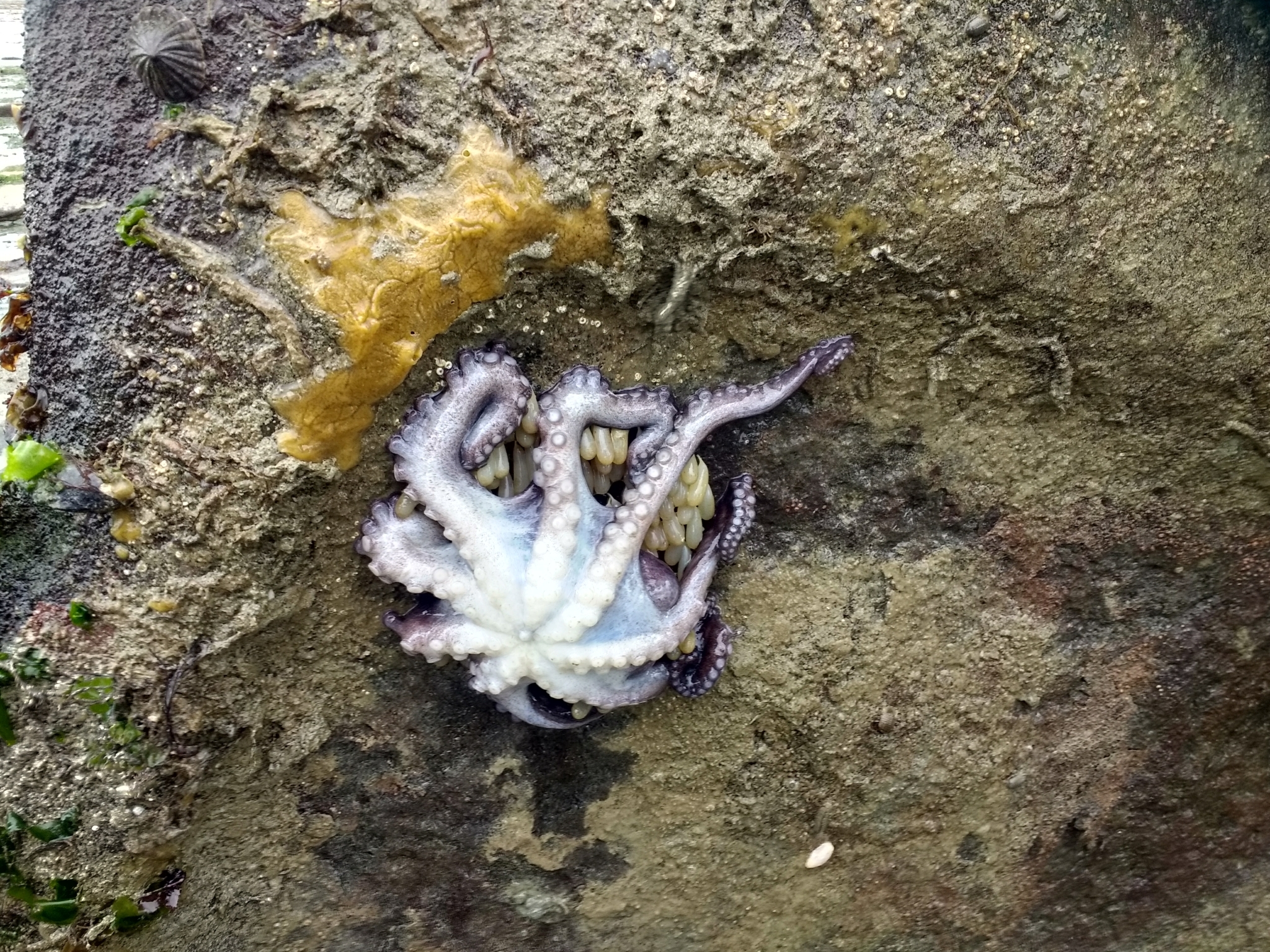 An octopus guarding her eggs. The nursery is the project now. The mother is apparently not invited to the long-term planning meeting.
First, the eggs
A female octopus does not casually lay a few eggs and hope for the best. Depending on the species, she may lay thousands, sometimes tens of thousands, of tiny eggs. She attaches them in strings to the ceiling or walls of a den, creating a hanging nursery that looks delicate, organized, and doomed to require constant maintenance.
Then she guards them.

The eggs need cleaning, oxygen, protection, and constant attention. The mother provides all of it, because nature is very comfortable with unpaid overtime.
This is not occasional supervision. She stays with the eggs for weeks or months, depending on the species and water temperature. Some deep-sea octopuses are known for even longer brooding periods.
During this time, the mother cleans the eggs with her arms, blows fresh water over them so they receive oxygen, removes debris, and protects them from predators. She rarely leaves the den. In many cases, she barely eats or stops eating altogether.
This is where the story becomes less “devoted mother” and more “biological countdown.”
Her body begins to weaken. Her skin may lose its smooth texture. Her movements become less coordinated. She may develop lesions. In some observed cases, females behave erratically or even injure themselves.
The clever animal that once hunted, hid, explored, and changed color is fading. The eggs are the priority. The mother is now the disposable packaging.
The self-destruct switch
For a long time, this looked like simple exhaustion. Maybe she was starving because she refused to abandon the eggs. Maybe death was just the cost of constant care.
But octopus biology had a stranger answer waiting.
Near the octopus brain are structures called the optic glands. Despite the name, they are not simply about vision. They are endocrine organs, meaning they release chemical signals that affect the body. In octopuses, these glands are heavily involved in reproduction, maturation, and the final decline after egg-laying.
In a classic experiment from the 1970s, scientist Jerome Wodinsky removed the optic glands from brooding female octopuses after they had laid eggs. The result was startling. The females stopped brooding, began eating again, grew, and lived much longer than expected.
This suggested that the mother’s death spiral was not just passive starvation. It was being driven by internal chemical instructions. Her body was not merely running out of energy. It was following a program. A terrible program, admittedly.
More recent research has explored what those glands are doing. Scientists have found that after mating, the optic gland changes its activity and appears to alter pathways related to steroid hormones and cholesterol metabolism. In simple terms: after reproduction, the octopus’s internal chemistry shifts dramatically. The gland seems to help trigger the behavioral and physical changes that lead to senescence, the final phase of decline.
So yes, “self-destruct” is not just a dramatic metaphor. It is not that the octopus consciously chooses to die. But her body appears to activate a built-in biological process that pushes her toward death after reproduction.
Evolution installed the button. Reproduction presses it.
Why would evolution do this?
At first, this seems like terrible design.
If octopuses are so intelligent, why not let the mother survive? Why not let her protect the hatchlings, teach them, and maybe give the next generation a better start?
The answer is that evolution does not reward what feels emotionally satisfying. It rewards what leaves enough offspring behind.
Many octopuses follow a strategy called semelparity. That means they reproduce once and then die. This is different from animals that reproduce many times across their lives, such as humans, elephants, birds, cats, and other creatures with more optimistic scheduling.
Semelparity can make evolutionary sense when an animal pours a huge amount of energy into one massive reproductive event. Instead of saving energy for future parenting attempts, the animal spends almost everything at once.
For octopuses, this may fit their lifestyle. They are solitary. They grow quickly. Many live short lives. Their young are often independent from the beginning. The mother’s main job is to get the eggs to hatching. Once the young emerge, they disperse and fend for themselves.
From evolution’s cold accounting perspective, a mother who survives afterward may not add enough extra benefit to justify the cost. Worse, in some theories, a surviving adult octopus might compete with or even prey on younger octopuses. Nature has a way of turning family reunions into ecological concerns.
So the system favors a brutal bargain: Grow fast. Mate once. Guard the eggs. Die.
The intelligence makes it stranger
The most unsettling part is not just that octopus mothers die after reproducing. Many animals die after reproduction. Salmon are famous for it. Some insects do it. The natural world contains many retirement plans with zero installments.
What makes the octopus different is the contrast.
This is an animal with a complex nervous system. It can learn. It can remember. It can investigate objects. It can manipulate its environment with arms that have remarkable independence. Some researchers describe octopus intelligence as deeply alien because so much of its nervous system is distributed through its arms.
An octopus is not a simple egg machine with suction cups.
It is curious. It explores. It solves problems. It appears to have moods, preferences, and an alarming talent for making aquarium staff reconsider their career choices.
And yet, after reproduction, all of that intelligence is placed inside a body that begins shutting itself down.
That is the strange tension at the heart of the story. The octopus is clever enough to escape a tank, but not its own life cycle.
There is something almost mythological about it: a creature of great intelligence, built for flexibility and survival, undone by a small gland near the brain.
The villain is not a shark. It is not hunger. It is not even old age in the ordinary sense.
It is an internal instruction.
Not all parenting looks like parenting
Humans tend to imagine parenting as a long relationship. Octopus motherhood is different. It is not about raising children. It is about guarding a future the mother will not share.
She does not meet her young in the meaningful sense. She meets the eggs. She tends them, cleans them, ventilates them, protects them, and gives them the best chance she can. Then the eggs hatch, and the hatchlings enter the ocean alone.
There is no inheritance except life itself, delivered at enormous cost. Her motherhood ends at the beginning of their lives.
A final note from the nursery
Nature has many ways to make a parent. The octopus version just comes with a self-destruct clause.